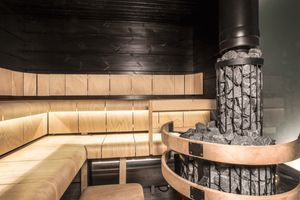
Sauna Ventilation: What Are the Most Important Considerations?
Expert material prepared in cooperation with sauna heater manufacturer HUUM.
The secret to a good sauna lies in a well-planned ventilation solution. Unfortunately, the significance of the air-exchange system and its planning is often underestimated when building a sauna. Yet oxygen-rich air is just as important as the capacity of the heater, the quantity of sauna stones, or the width and height of the sauna bench.
Improper air circulation in the steam room results in a lack of air and discomfort. If the ventilation system is not built correctly, the air stratifies and the temperature at the lower levels of the bench drops.
Layered air caused by poorly planned ventilation is one of the most typical mistakes in sauna construction.
The type and construction of the ventilation system depend on which kind of heater you have. So make sure you think about ventilation when choosing a heater for your sauna.
What a Ventilation System Consists Of
A typical ventilation system is made up of three parts (sometimes two):
- Supply air pipe - brings in fresh air
- Exhaust air pipe - removes used air
- Drying pipe - used to dry the sauna after use
Your ventilation solution depends on whether the room has gravity-based ventilation or mechanical ventilation. In general, the supply air pipe should be positioned close to the heater at the proper height, so that the incoming colder air reaches the heat of the heater, warms up, and creates circulation in the room.
The Choice of Ventilation System Depends on the Heater Type
Air circulation in the steam room must correspond to the particular heater. Electric heaters require a different ventilation solution than wood-burning ones. You must also consider whether the heater door (hearth) is inside the steam room, or whether the heater is filled from outside.
The construction of the heater also plays a role. When planning your ventilation, it is important to know the difference between closed-sided heaters and open or net-heaters.
Closed-Sided Heaters
The air circulates from bottom to top and the stones are placed on top of the heater. A very common mistake is placing the supply air pipe in the middle of a closed-sided heater, where there is no air access. In this case the incoming air is not heated properly and sufficient circulation will not occur. It does not matter whether the closed-sided heater is electric or wood-fired. The incoming air should be directed underneath the heater or above it, according to the particularities of the sauna and the heater.
Net-Heaters
The sides are open and the stones sit inside a massive net with plenty of air access from all sides. The supply air pipe should be placed in the middle of the heater. This directs air to the centre of the heater, where it is heated and lifted to create air circulation in the room.
Drying
All saunas must have a drying pipe. As its name suggests, this pipe is used for drying the sauna after use. It can be opened if the sauna has too much moisture or lacks sufficient oxygen. If possible, though, the drying pipe should be left for drying the sauna, not for fixing other problems.
The drying pipe should be closed during the sauna session, because the heat in the room may become layered and leave your feet cold. Locate it away from the heat source - in the ceiling or high on the wall.
Mechanical Ventilation
Mechanical ventilation systems are alike for electric heaters and for heaters fed from the antechamber (i.e. no hearth door in the steam room). Wood-fired heaters fed from the steam room, however, require special attention.
Layout drawings
First take a look at the table and diagrams, then see the detailed descriptions below.
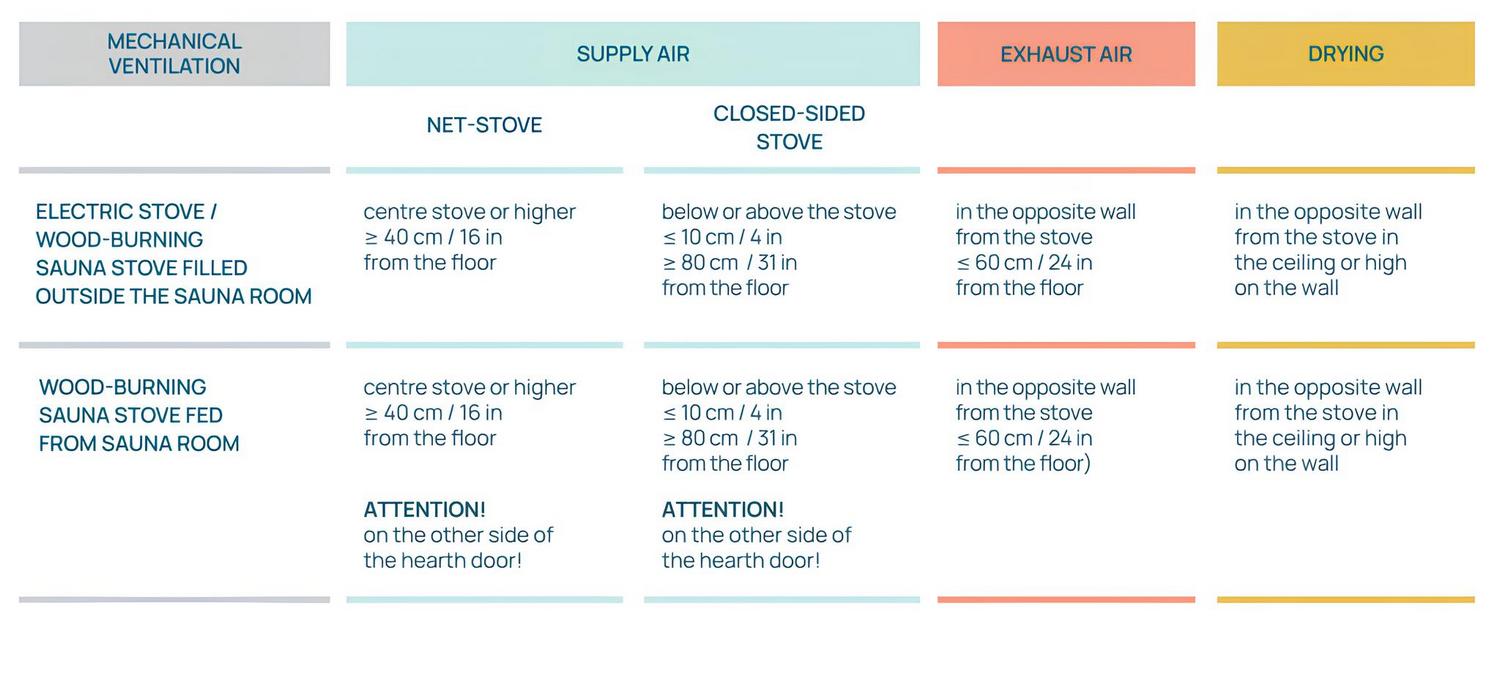
Mechanical ventilation - overview by heater type (source: HUUM)
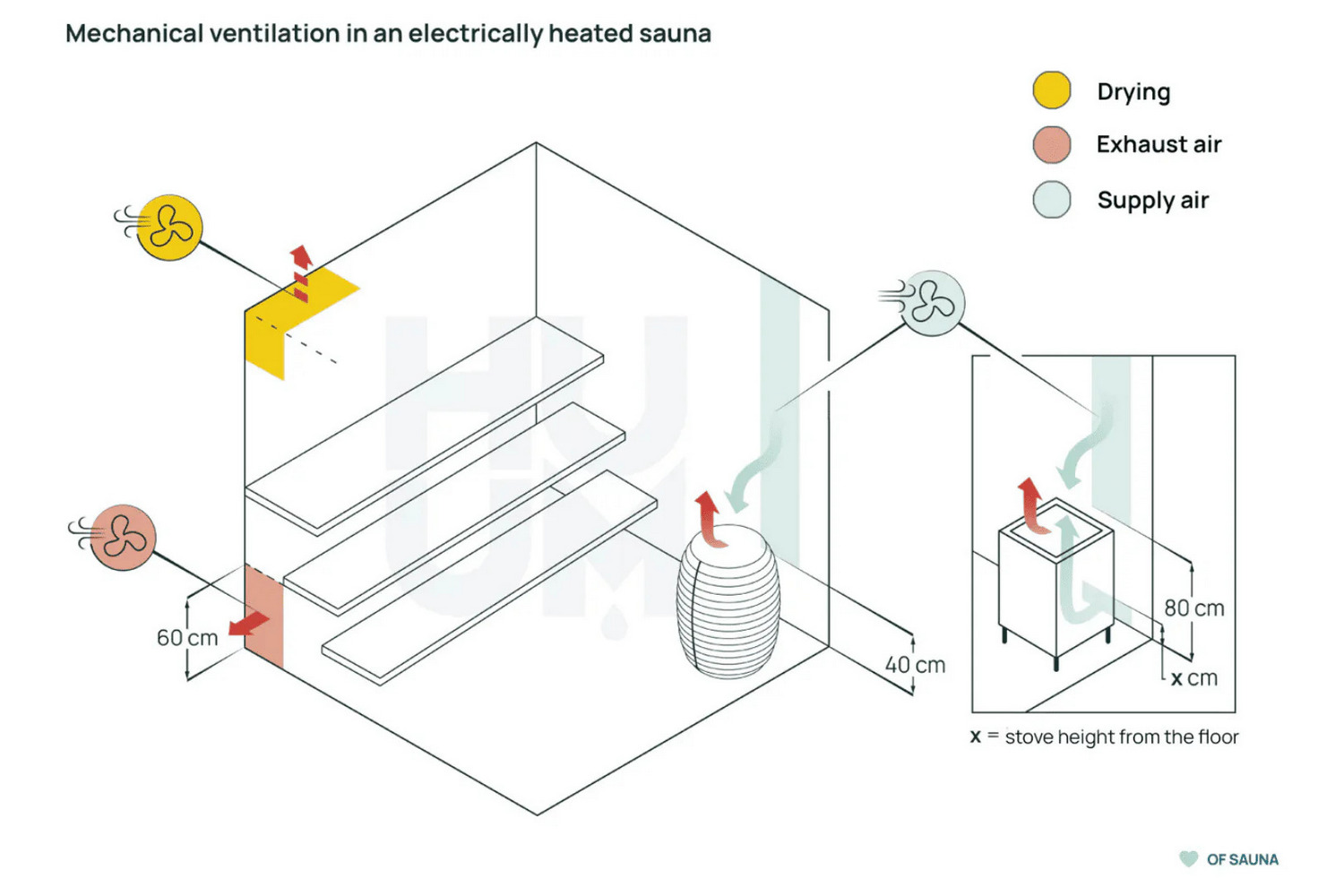
Mechanical ventilation in an electrically heated sauna (source: HUUM)
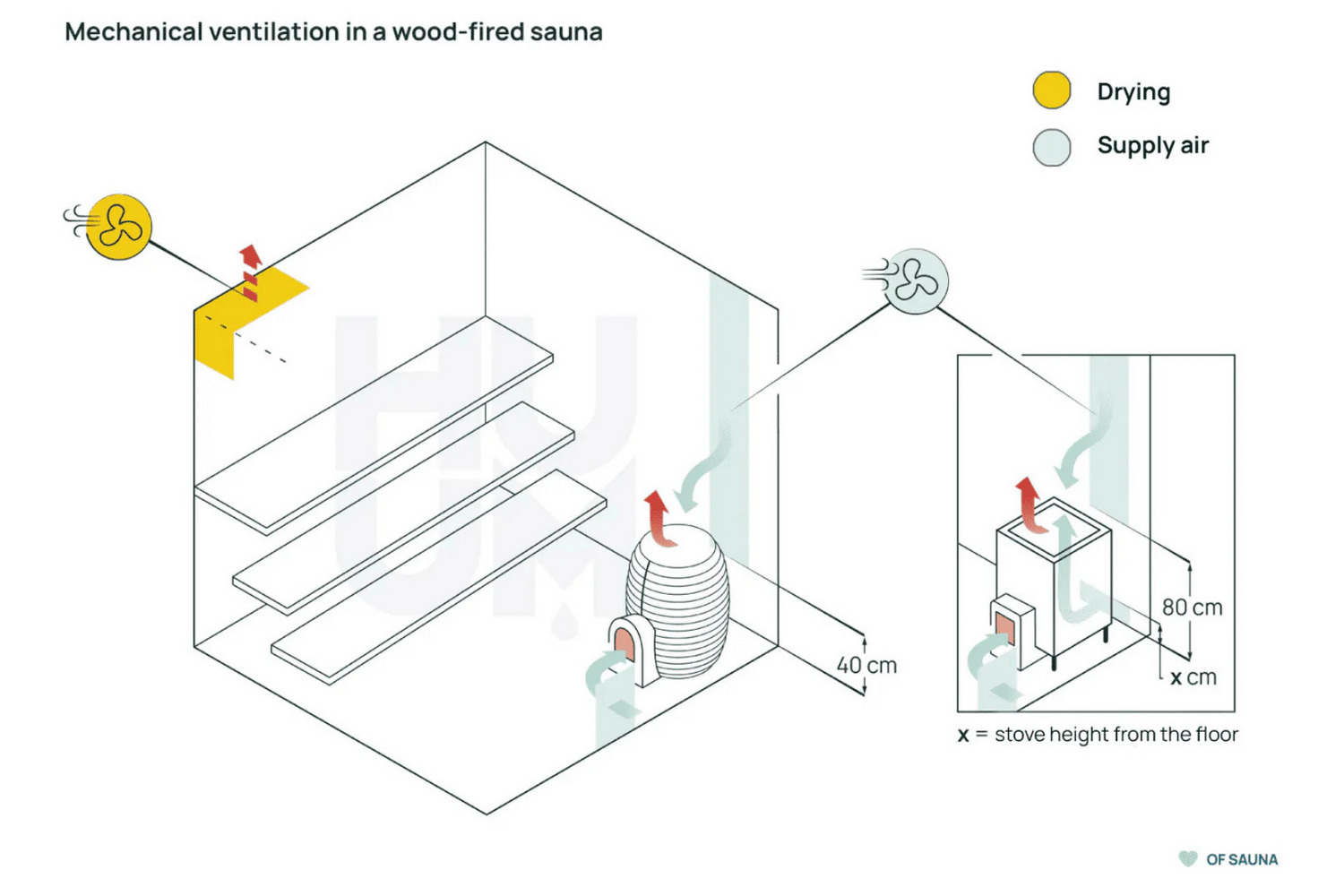
Mechanical ventilation in a wood-fired sauna (source: HUUM)
Supply Air
Saunas with closed-sided heaters may use two different supply air pipe solutions. One option is to build the supply air pipe directly above the heater (no lower than 80 cm from the floor). The incoming cold air then falls onto the heated stones, warms up, and creates circulation. The other option is to direct the incoming air below the heater, where it is sucked into the hot heater.
In the case of net-heaters, the incoming air should be directed to the middle section of the heater (but no lower than 40 cm from the floor).
Whether you have a closed-sided heater or a net-heater - if it is wood-fired, the supply air pipe must be on the opposite side from the hearth door. If the supply air pipe is close to the hearth door, the air will exit through the hearth without entering circulation.
If a wood-fired sauna has mechanical ventilation, it requires extra oxygen for burning. To that end, build an additional supply air pipe close to the hearth. Please consult the cross-section of the air inlet provided by the heater manufacturer.
Exhaust Air
The exhaust air pipe should be built into the wall opposite the heater, no more than 60 cm from the floor, just behind your feet. Since the air is circulated mechanically, however, its height is not too important - the exhaust air pipe can even be below the supply air pipe.
⚠️ Installing mechanical ventilation requires a professional. If installed or maintained improperly, a mechanical ventilation system with a wood heater may cause low air pressure and generate dangerous levels of carbon monoxide (CO). The entire ventilation system of a building must function as one.
Gravity-Based Ventilation
Whether using an electric heater or a wood-fired heater filled from the antechamber, the logic of gravity-based ventilation is the same. With a wood-fired heater filled from the steam room, however, the logic differs.
Layout drawings
First take a look at the table and diagrams, then see the detailed descriptions below.
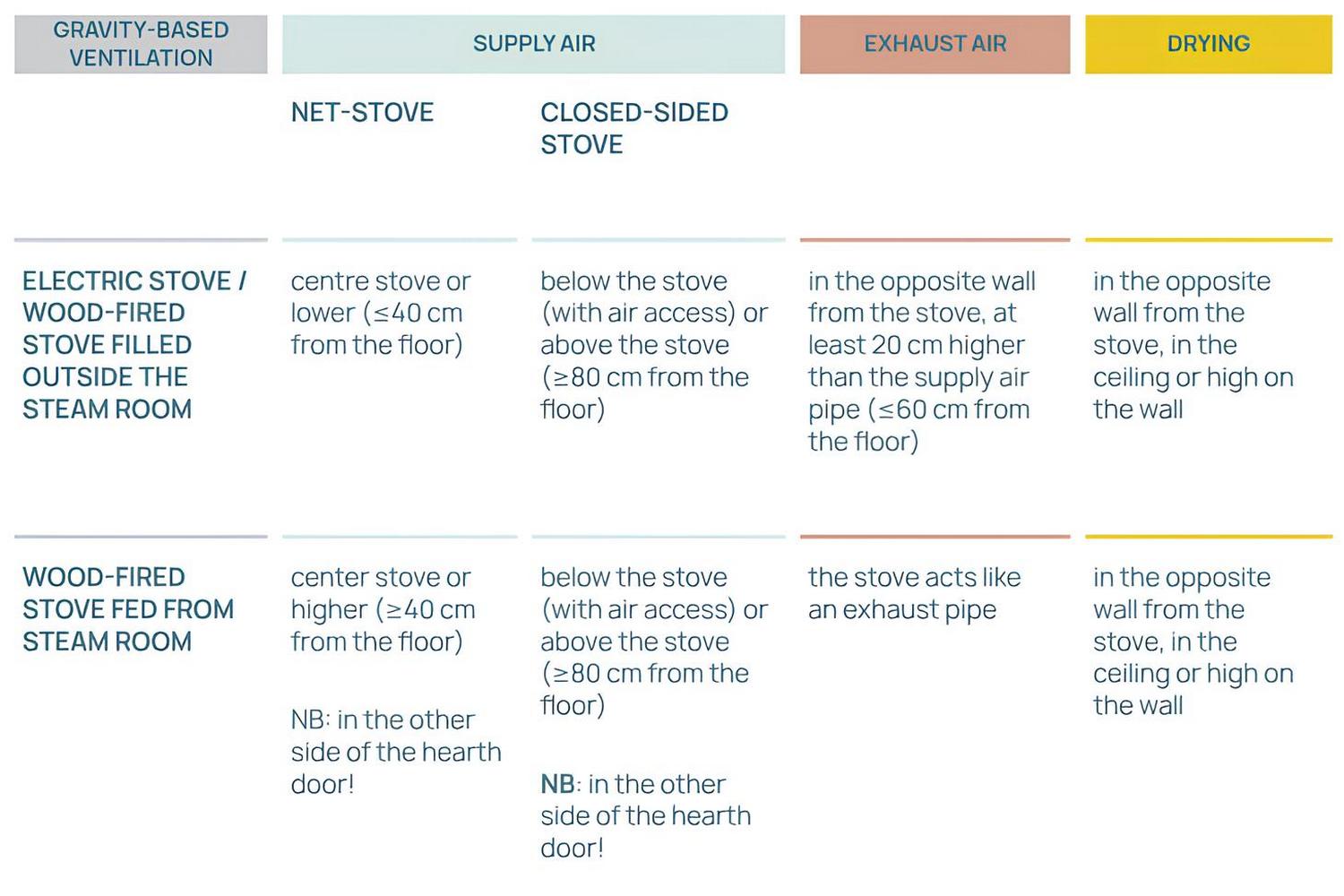
Gravity-based ventilation - overview by heater type (source: HUUM)
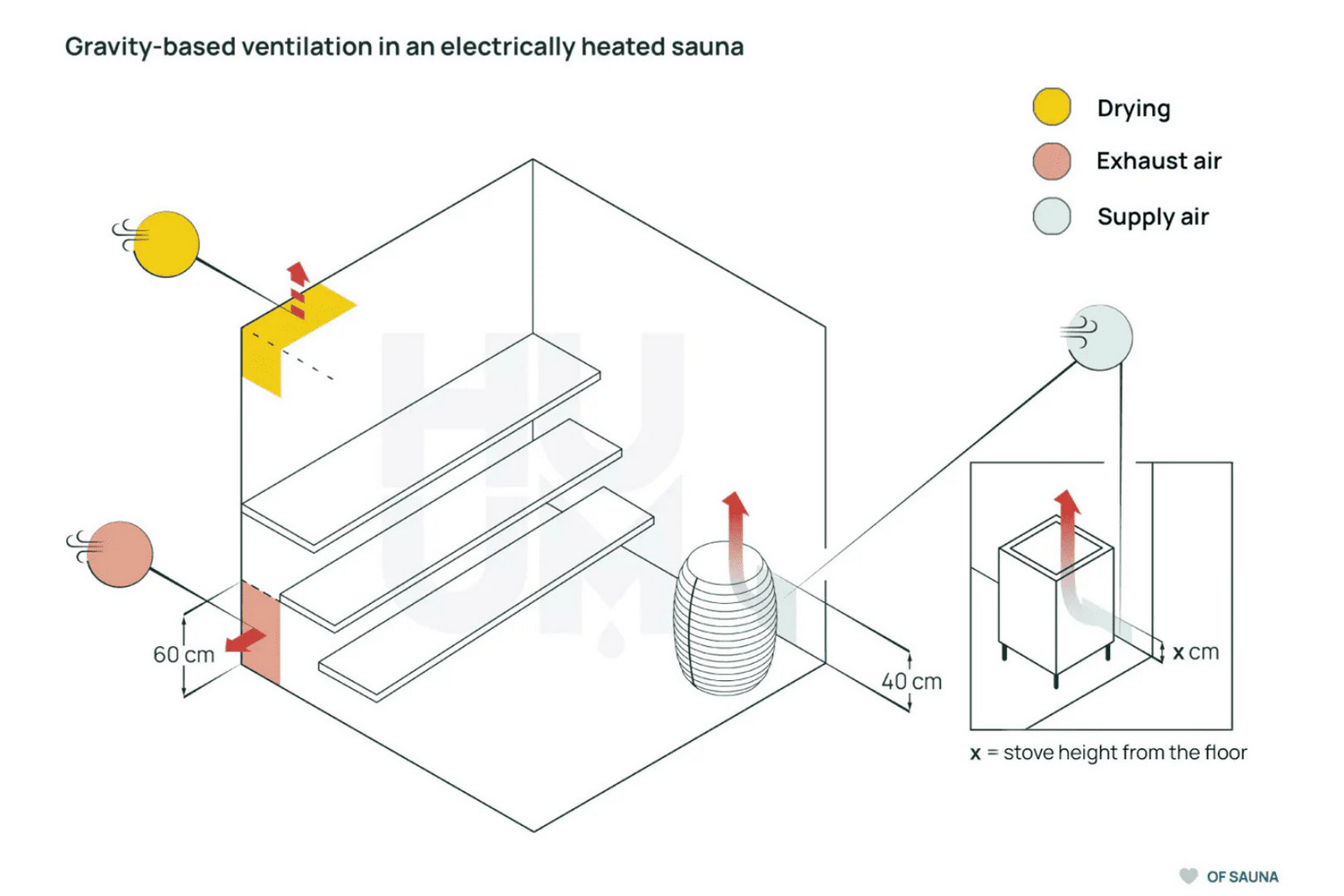
Gravity-based ventilation in an electrically heated sauna (source: HUUM)
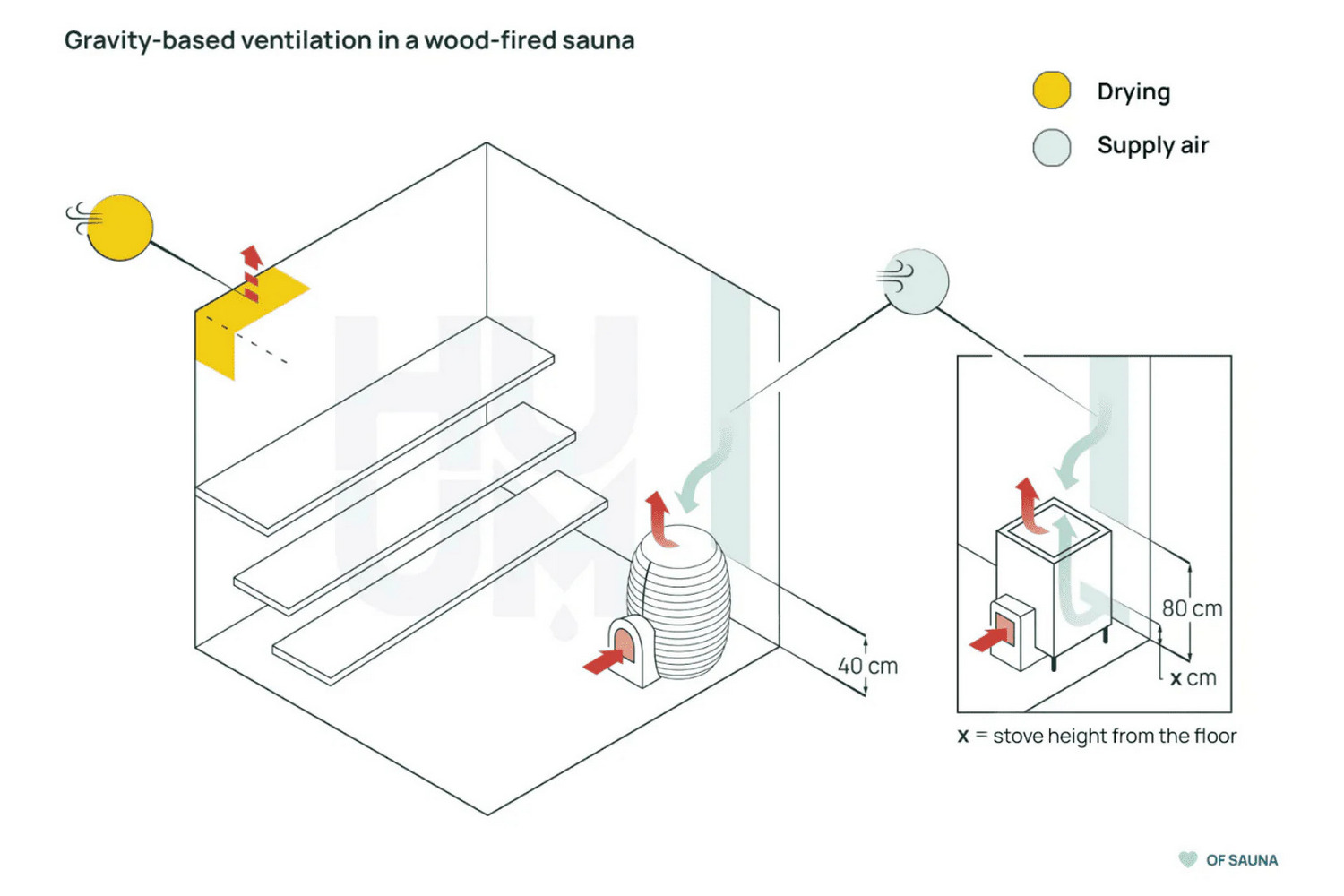
Gravity-based ventilation in a wood-fired sauna (source: HUUM)
Supply Air - Electric Heater or Wood-Fired Heater in the Antechamber
For a closed-sided heater with gravity-based ventilation, the supply air pipe should be built close to the floor, at a height where air can access the heater from below, warm up, and generate circulation. The other option is to build the supply air pipe just above the heater (no lower than 80 cm from the floor).
For a net-heater, the supply air pipe should be built roughly in the middle of the heater (no higher than 40 cm from the floor).
Supply Air - Heater With Hearth Door in the Steam Room
Using an ordinary closed-sided heater, the supply air pipe should be built at the height of the lower air-circulation zone. Importantly, it must be on the opposite side of the heater from the hearth door - otherwise the incoming air will exit the steam room without generating circulation. The other option is to build the supply air pipe just above the heater.
For a net-heater, the supply air pipe should be built in the middle of the heater or higher (no lower than 40 cm from the floor).
Exhaust
With an electric heater or a wood-heated heater filled from the antechamber, the exhaust pipe should be built into the wall opposite the heater. It should be at least 20 cm higher than the supply air pipe, but no higher than 60 cm from the floor.
A heater with a hearth door in the steam room does not require a separate exhaust pipe - the heater itself acts as an exhaust.
Conclusion
The importance of good ventilation in the sauna room cannot be overstated. You may have experienced how hard it is to breathe in a poorly ventilated room, where oxygen levels are low and dizziness sets in. The heat can also be tiring on the body.
That is why a steady supply of fresh air is crucial to ensure the sauna experience is invigorating rather than exhausting. Consider ventilation already when choosing a heater - the type of heater and the ventilation of the entire building must be taken into account to ensure proper air exchange.
If you're uncertain, don't hesitate to seek the advice of an expert. The Greus team will gladly help you choose a HUUM heater and design the right ventilation solution for your sauna.
Contact
📍 Showroom: U Elektry 830/2B, Praha 9 - Hloubětín, Czech Republic
📞 +420 775 84 80 81 ✉️ office@greus.com 🌐 greus.com